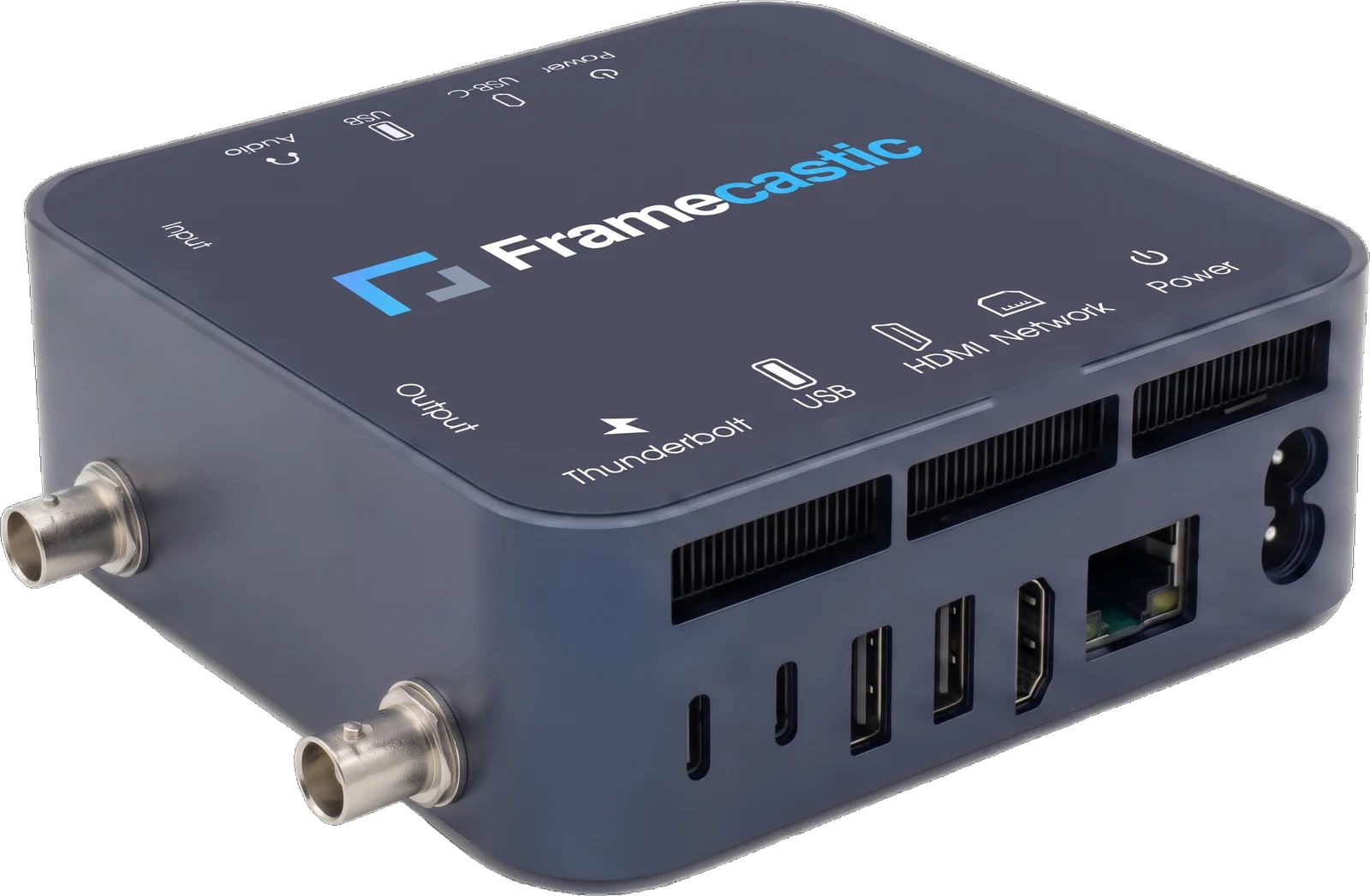
The Framecastic Portable Codec runs an encoder (SDI → IP) and a decoder (IP → SDI) at the same time on one box, on a duplex SDI card. It is built for field contribution and remote-bureau work: send the programme out and take the return feed back on the same unit. Its technical argument is HEVC 4:2:2 10-bit in hardware, on both encode and decode, in a class where that is rare. It runs the same codec software and REST API as the rest of the Framecastic SDI range, and is available turn-key or as a software-only licence on the customer's own qualified Intel hardware.
Signal Flow: Both Directions Run Together on One Box
Encode
SDI In
SDI card
Hardware Encode
H.264 / HEVC
MPEG-TS over IP
UDP · RTP · SRT · RIST
Decode
IP In
UDP · RTP · SRT · RIST · RTMP · RTSP · HLS
Hardware Decode
H.264 / HEVC
SDI Out
SDI + stereo audio
Key Features
One SDI input and one SDI output, running simultaneously: 1 encoder + 1 decoder, not two of either
Hardware H.264 and H.265 (HEVC) encode and decode
HEVC 4:2:0 and 4:2:2, 8-bit and 10-bit, on both encode and decode
Return video on the same unit as the outgoing programme
Per-stream transport: UDP, RTP, SRT or RIST
Either end may be caller or listener for SRT and RIST, independent of the media direction
Selectable low-latency and normal-quality decode profile per stream
Up to 16 embedded audio channels captured on encode, with arbitrary channel-to-track mapping
Decoder input also accepts RTMP/RTMPS, RTSP, HLS and HTTP(S), plus a local file with seamless loop and a built-in test pattern
DSCP QoS marking per output, verified on the wire
WireGuard dial-home to the central Hub for remote sites
HTTPS web UI behind login, full REST API
Available turn-key or as a software-only licence
Encoding (SDI → IP)
Interface
1× SDI in (BNC), M.2 SDI card
Video Codec
H.264 (4:2:0, 8-bit) · HEVC 4:2:0 and 4:2:2, 8 and 10-bit
Validated Formats
1080p50 and 1080p60 on the shipping platform, encoding and decoding at once at the full 50 Mbps.
720p50
Supported in every codec mode on the shipping platform.
1080p60 exception
All modes run at full rate except HEVC 4:2:2 10-bit, which is not recommended for sustained 60p. Use 4:2:0 10-bit or 4:2:2 8-bit at 60p.
1080i50
Carried at full rate with both fields preserved. The encoded stream is progressive-coded and carries no field-order signalling, so a downstream decoder has to be configured for interlaced content.
Rate Control
True CBR, configurable up to 50 Mbps
Audio In
Up to 16 embedded SDI channels, arbitrary channel-to-track mapping
Audio Codec
AAC, MPEG-1 Layer II, Opus, PCM (SMPTE 302M)
Decoding (IP → SDI)
Interface
1× SDI out (BNC), same card
Decode
H.264, HEVC 4:2:0 and 4:2:2, 8 and 10-bit. Hardware.
Embedded Audio Out
Stereo (2 channels) only, today
Decode Profile
Selectable low-latency or normal-quality buffering, per stream
Inputs Accepted
UDP, RTP, SRT, RIST, RTMP/RTMPS, RTSP, HLS, HTTP(S), local file (loop), built-in test pattern. These are inputs; the unit has no RTMP, HLS or WHIP output.
Duplex
Encode and decode run together on one box, which is what makes return video work. For sustained duplex at 50 Mbps, HEVC 4:2:2 10-bit is not the mode to pick; 4:2:0 10-bit and 4:2:2 8-bit hold full rate.
Encode Format Support, by Codec Cell and Video Format
1080p50
1080p60
720p50
1080i50
H.264 4:2:0 8-bit
Full rate
Full rate
Screened
Full rate
HEVC 4:2:0 8-bit
Full rate
Full rate
Screened
Full rate
HEVC 4:2:0 10-bit
Full rate
Soak 30 min
Screened
Full rate
HEVC 4:2:2 8-bit
Full rate
Full rate
Screened
Full rate
HEVC 4:2:2 10-bit
Soak 30 min
Decays to ~0.945×
Screened
Full rate
H.264 4:2:2, any depth
Not possible
Not possible
Not possible
Not possible
Soak 30 min held full rate for thirty minutes with no dropped or duplicated frames. Full rate ran clean but has not been soaked. Screened passed a 45-second cell only, and no figure from it may be quoted until a soak is run: one cell passed its screen and then failed its soak, which is why the distinction is kept here. HEVC 4:2:2 10-bit at 1080p60 screens at 60.0 and then settles to about 0.945 of real time over thirty minutes; use 4:2:0 10-bit or 4:2:2 8-bit for sustained 60p. H.264 4:2:2 is not possible on Intel media hardware, on any generation, and is not a roadmap item. 1080i50 runs everywhere but is progressive-coded, see above.
Models
FC-CODEC-1X1
Turn-key unit: compact Intel N-series box with the M.2 SDI card card, 1 encode + 1 decode. Price on request.
FC-CODEC-1X1-SW
Software-only licence for the customer's own qualified Intel box with the same card. Price on request.
Software licences are perpetual: buy once, own it. An optional annual SLA covers support and firmware. Validated platforms: Intel N150 and Core 3 304 (Wildcat Lake). The kernel and Intel media stack are pinned per platform, keyed to the integrated GPU rather than the CPU marketing name; turn-key units ship with that stack already pinned.
Chassis ventilation is part of the specification, not an accessory: capture-card temperature depends on it.
Environment
0 °C to +40 °C · 10–90% RH, non-condensing
Regulatory
Certification status to be confirmed
Warranty
2 years hardware, 1 year software updates, included
Not in This Release
No ST 2022-7 or other dual-path redundancy
No timecode, closed captions, teletext or other ancillary data, in either direction
No multiple output destinations and no proxy sub-stream
No RTMP, HLS or WHIP output, and no live video preview in the UI
No local recording
No SNMP or syslog forwarding
No user roles, password policy, audit log, custom CA or 802.1X
No authentication on the central Hub, and therefore no fleet-wide access control and no audit trail naming a person. Device-local access control is enforced and provable; fleet-wide is not.
No customer-driven update
No interlaced coding: the stream is progressive-coded and carries no field-order signalling
No decoder genlock exposed, although the card carries a reference input
No 16-channel decoder audio
No NDI, Zixi, JPEG XS or Dolby passthrough
No 4K/UHD, HDR, scaling or frame-rate conversion, out of scope by customer request